
Community resilience
Useful energy begins
with local needs.
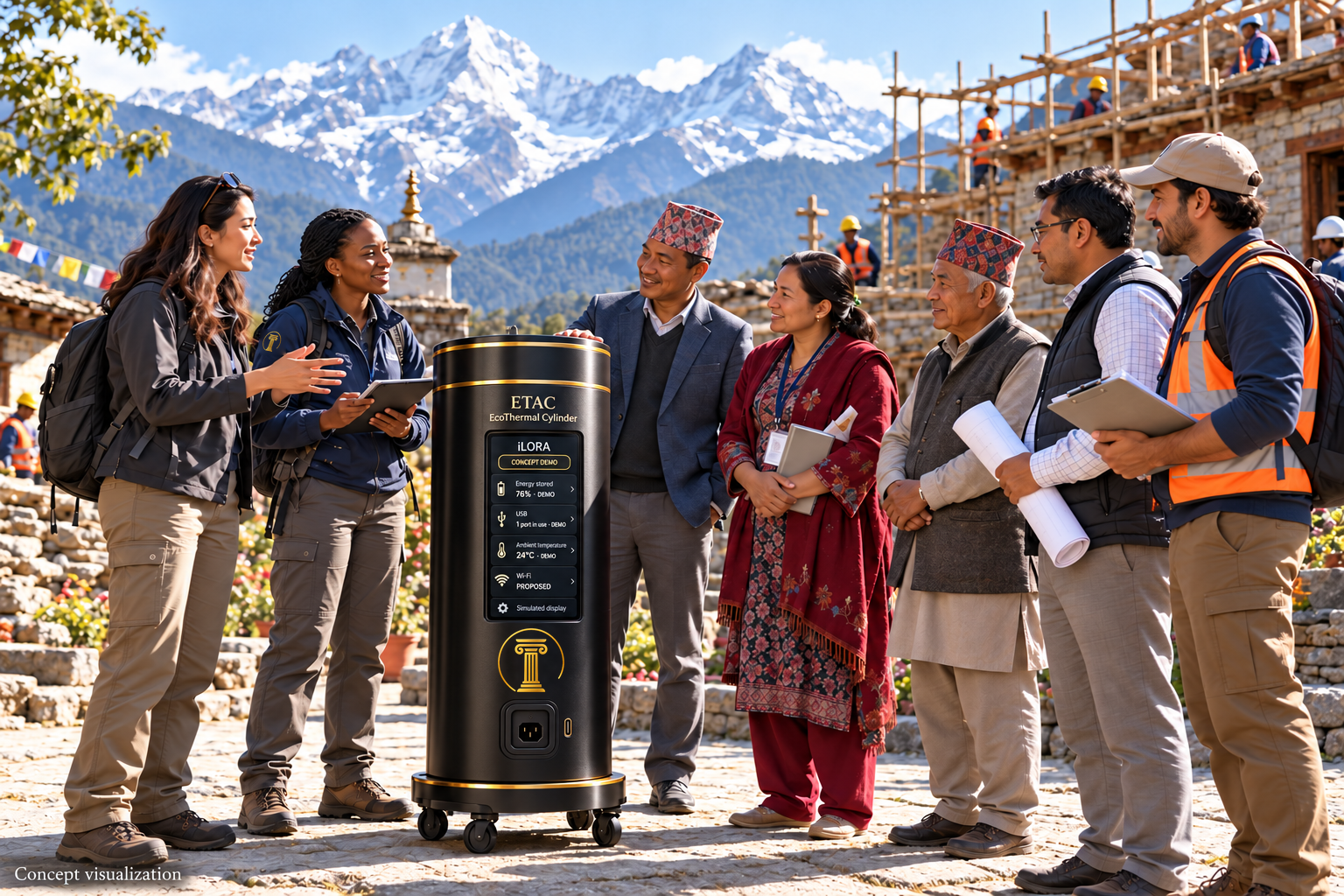
A conceptual ETAC demonstration in a Nepalese mountain community exploring recovery, reliability, and the practical realities of energy access.
Concept demonstrationHow this serves the mission
Resilience should answer local priorities.
An energy concept is only useful if it fits the place and the people who would use it. The Nepal scene explores a possible connection between energy access and family communication. Future planning would begin with residents’ priorities, existing services, repair capacity, accessible controls, and the realities of climate and transport—not an assumption that one device can solve every disruption.

The problem
Why this matters.
Power interruptions and disrupted infrastructure can make communication, study, essential logistics, and recovery more difficult.
Who is affected
People at the center.
Mountain communities, families, students, local service providers, relief workers, and infrastructure teams.
The proposed response
Investigate whether a validated ETAC system could play a useful role alongside established energy and communications infrastructure.
A suitable future system might support selected local needs, if useful net output, safety, climate suitability, maintainability, and cost are established.
Plan with the community
The illustration imagines residents and relief or engineering teams discussing energy needs after disruption. Local priorities, maintenance capacity, existing infrastructure, transport, and access must shape any proposed deployment.
Explore the full energy pathway
Research includes thermal capture, waste-heat recovery, storage, temperature differentials, conversion methods, connectivity, and device charging. Every application depends on suitable sources and engineered systems; none is demonstrated as operational here.
Winter is an open question
Cold-weather performance, exposure, heat losses, material behavior, transport, maintenance, and safe operation require testing. The mountain setting does not establish that ETAC works in winter or disaster conditions.
ETAC exterior interface
Understandable information. Clear limits.
This is an interface illustration, not device telemetry. No measurements or performance figures are represented.
ETAC CONCEPT DEMO
External controls only
A proposed charging interaction.
The Nepal illustration shows a woman connecting a phone as a possible future use. It does not verify electrical output, successful charging, internet service, or an actual deployment.
Ambient heat alone does not guarantee electricity. Suitable sources, temperature differences, conversion, safety, and winter performance remain research questions.
Read the public research agenda →Available today
What this page offers.
This page and the illustrative interface work as a website demonstration. No ETAC deployment, electricity supply, internet service, charging service, or local partnership is verified.
Development status
Concept demonstrationThe described capability or program remains at the stage shown here. Images are illustrative, and no availability or performance is established by a rendering.
Review the research scope →