
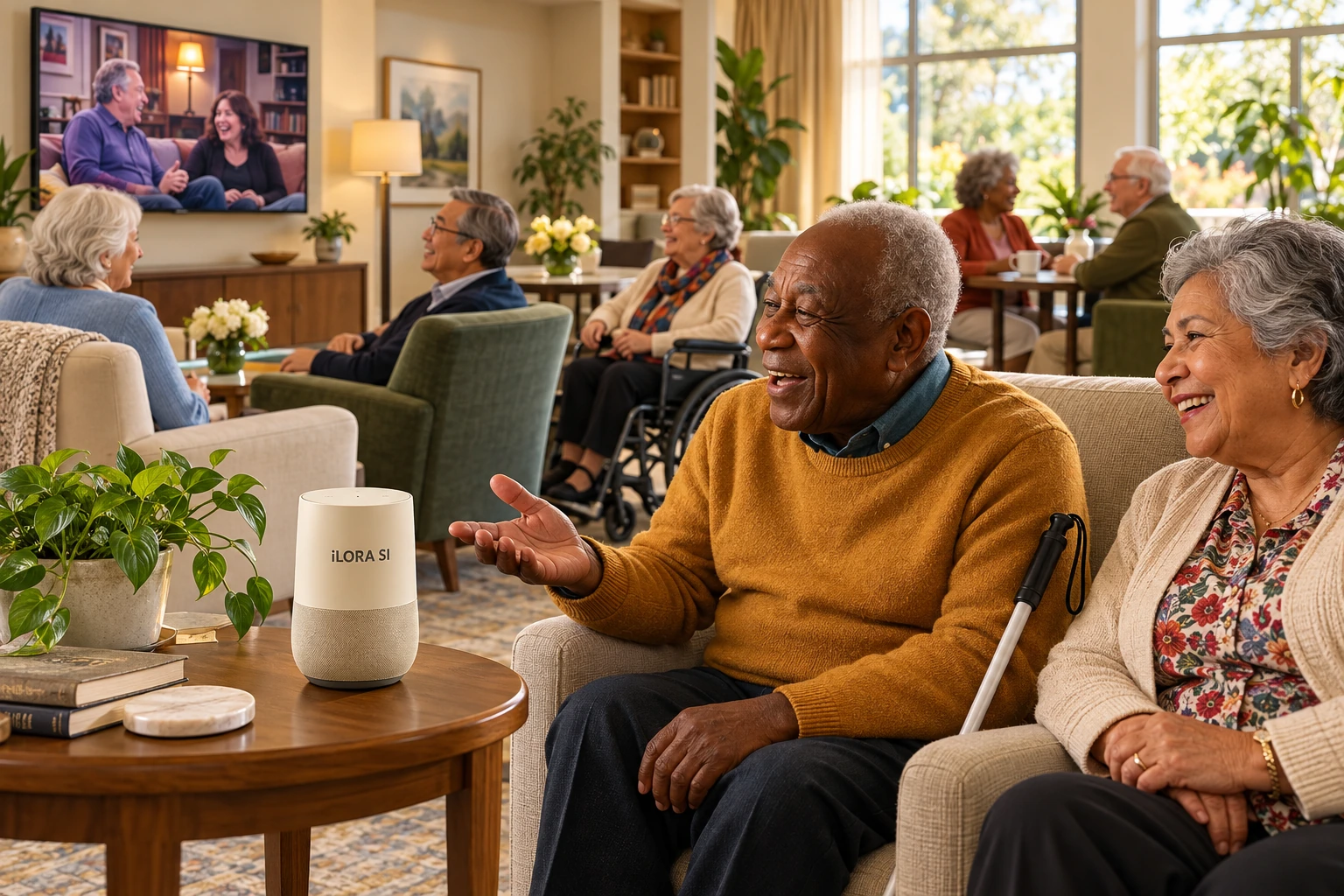
Elder care & shared living
A lounge, a shared television experience, and optional descriptions chosen by the individual.
Explore the shared living concept →
Intelligence with a human purpose
A long-term vision for intelligent, accessible assistance that helps people learn, navigate information, and participate more independently in daily life.
Research conceptsHow this serves the mission
ALARIS is envisioned as an approachable assistant for learning, information, and daily-life support. The starting questions are practical: could a person locate a dropped object, understand a display, hear written information, or communicate through a format that suits them? iLORA SI names the longer-term research ambition; it is not evidence that superintelligence has been achieved.
The problem
Complex information and inaccessible interfaces can make everyday learning and participation difficult.
Who is affected
Learners, older adults, people with disabilities, families, and other future users.
The proposed response
Useful future assistance could make information easier to navigate within clearly defined limits.
SI means Superintelligence in the iLORA vision. It is an aspirational research direction. This site does not claim that iLORA has achieved superintelligence, human-level general intelligence, or a proprietary deployed model.
ALARIS is envisioned as an accessible interface across learning, information, and carefully bounded support tasks. Proposed interactions include text, voice, and visual assistance, with user control over permissions and information sharing.
The concept explores voice and spoken descriptions for people who cannot use a visual interface, captions and text for people who cannot use audio, and controls suited to limited mobility or speech. Accessibility preferences should shape the interaction; no single format serves everyone.
Earlier planning considers licensed external models as a possible starting point, followed by specialized iLORA software and research where evidence supports it. This is a development strategy, not a claim of current provider agreements, deployed integrations, or a proprietary model.
The proposed architecture prioritizes clear limits, sources where useful, understandable consent, and human review for consequential decisions. No live ALARIS assistant, medical monitoring, or emergency-response service is connected to this prototype.
A useful distinction
Neither name represents a live intelligent service on this prototype. Explore the proposed architecture and the evidence needed to move it forward.
Understand the development stages →The assistant experience
Open a proposed interaction to understand its purpose and what would need evaluation.
The proposed assistant could help someone explore written information through clearer formatting, explanation, and source context. A useful evaluation would check accuracy, understandable uncertainty, and whether the person can verify the result.
The vision includes spoken descriptions, text alternatives, captions, and communication preferences chosen by the user. A future voice or visual interaction would need explicit permission and an accessible way to stop it.
The assistant could help organize a learning question or a chosen daily routine. Consequential decisions would retain appropriate human review. Medical, emergency, or independent decision-making capabilities are not established.
Explore the concepts
Follow each subject to its own explanation. All devices and settings shown are concepts.
A lounge, a shared television experience, and optional descriptions chosen by the individual.
Explore the shared living concept →Available today
This website is operational as a prototype. No live ALARIS assistant, proprietary model, superintelligence, clinical monitoring, or emergency service is connected.
Development status
Research conceptsThe described capability or program remains at the stage shown here. Images are illustrative, and no availability or performance is established by a rendering.
Explore independent living →